Collect reviews from every chat, the honest way
The best moment to collect reviews is the minute a problem gets solved. txt.me asks every customer to rate the chat when it ends, routes low ratings to your team so you can fix the issue, and offers everyone the links to your public review profiles.
Why it's hard to collect reviews that reflect your service
Most customers who had a fine experience never write a review. They got their answer and moved on. The ones who do write often had a bad day, and a single angry post can sit at the top of your profile for months. So the public picture of your service ends up skewed in the wrong direction.
The tempting fix is to ask only the happy customers. That's known as review gating, and it's a trap. The US Federal Trade Commission's guide for marketers says it plainly: "Don't ask for reviews only from customers you think will leave positive ones" (FTC, Soliciting and Paying for Online Reviews). Major review platforms have similar rules, and a profile can be penalized for breaking them.
How txt.me collects reviews after each chat
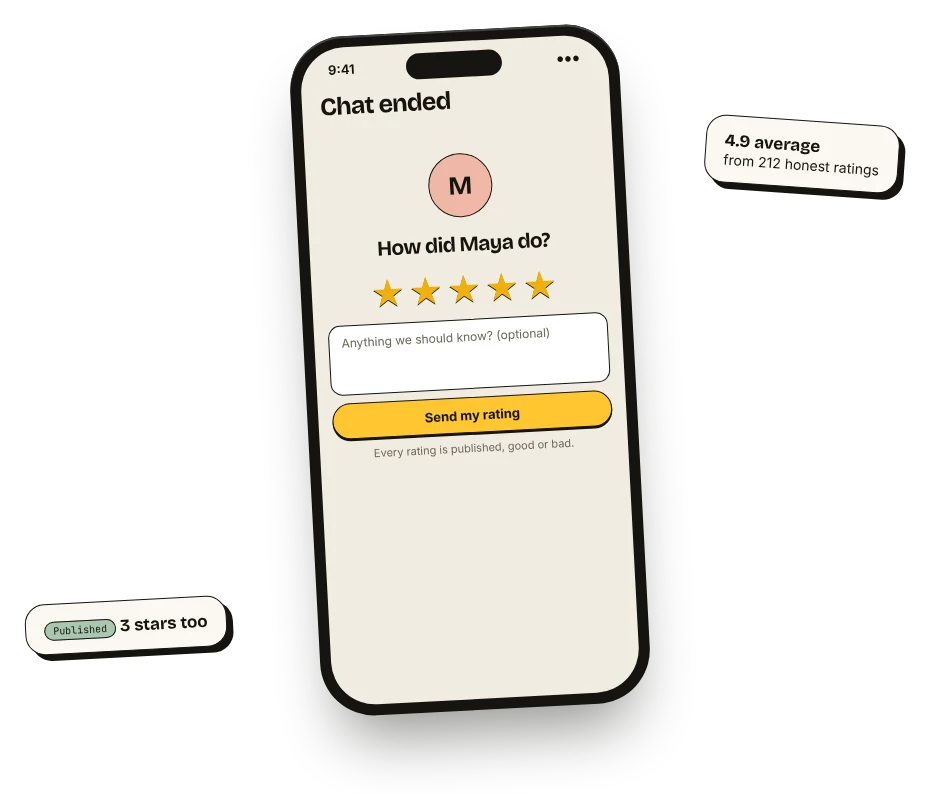
- The customer rates the conversation. When the chat ends, the widget asks for a rating from 1 to 5 stars. It takes one tap, so response rates are much higher than an email survey sent a week later.
- Everyone sees your review links. Every customer who rates the chat gets the same invitation to share their experience on your public profiles, whatever score they gave.
- Low ratings reach your team. If the rating is 3 stars or less, the widget also asks what went wrong and adds the answer to the chat. Your team can reply while the customer is still there, often before they've decided to post anywhere.
That third step is where the value is. You don't hide unhappy customers; you get to them first. A customer whose problem is fixed in the next ten minutes may still leave a 3-star review, but it's likely to be a fair one.
Send customers to the review sites that matter to you
You add the links to your profiles in the reviews settings: your map listing, your app's page in the app stores, or a page on a software review directory. Customers see the ones you choose, and one tap opens the right page.
Ratings and comments are stored on the conversation. In the reviews report you can filter by agent and by week, which turns ratings into coaching material. If the same complaint keeps coming up, it's usually a policy or product issue, not an agent issue.
The rules for collecting reviews in the US
In August 2024 the FTC announced its final Rule on the Use of Consumer Reviews and Testimonials (16 CFR Part 465). It lets the agency seek civil penalties against knowing violators. Three parts of it touch on how you collect reviews:
- No sentiment-conditioned incentives. The rule prohibits "compensation or other incentives conditioned on the writing of consumer reviews expressing a particular sentiment, either positive or negative" (FTC press release, 2024). A gift card "for a 5-star review" is out.
- No review suppression. You can't use groundless legal threats or intimidation to remove a negative review. If you show reviews on your own site, you can't present them as all or most of the reviews you got after filtering out the negative ones.
- Insiders must disclose. Reviews by employees, managers or their relatives need a clear disclosure of the connection.
txt.me is built around those rules. The invitation to review goes to every customer, the platform never attaches a reward to a score, and low ratings are routed to your team, not hidden. This isn't legal advice, and rules change, so it's worth reading the FTC pages yourself or asking your lawyer if you plan to add incentives.
Small changes that lift review numbers
The timing does most of the work. A rating request that appears the second the agent writes "Is there anything else I can help with?" gets answered far more often than one that appears after the customer has closed the tab. Ending chats with a clear close, rather than letting them fade out, gives the widget that moment.
Agent photos help too. People rate a person more readily than a logo. Our help article on customer service reviews covers what to do with the feedback once it arrives, and how to collect real reviews with live chat walks through the settings.
Frequently asked questions
How does txt.me collect reviews?
Is it legal to ask only happy customers for reviews?
Can I offer a discount for leaving a review?
Which review sites can I link to?
Where do I see the ratings?
Put an AI agent and a real person on your website chat
Start free with one agent and unlimited chats. Add the AI agent, WhatsApp, email and Human Backup operators when you need them.