AI Agent for Customer Service: A Practical Buying Guide
A practical guide to choosing a support AI, defining its permissions, testing its answers, and measuring resolved problems rather than closed chats.
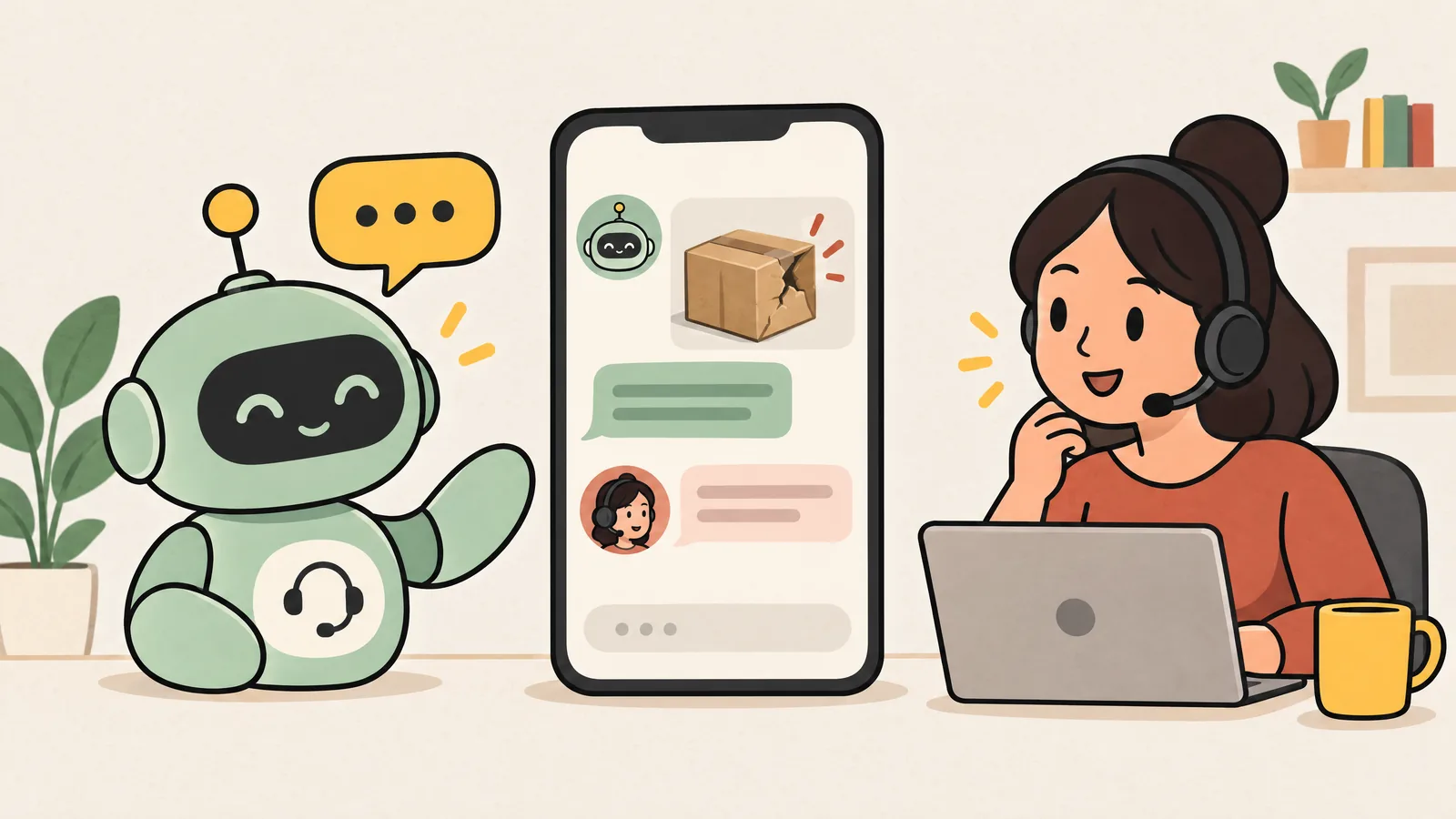
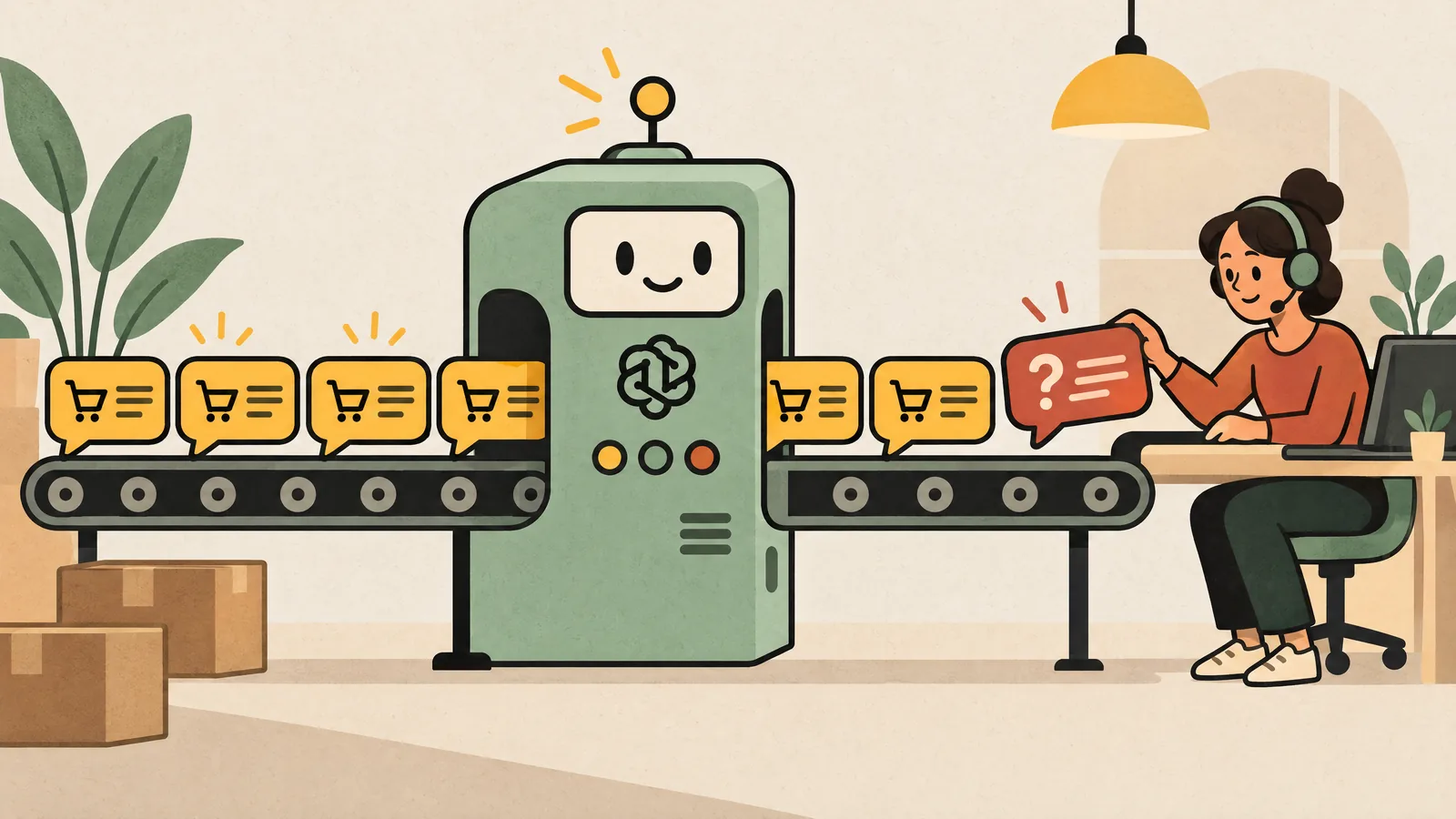
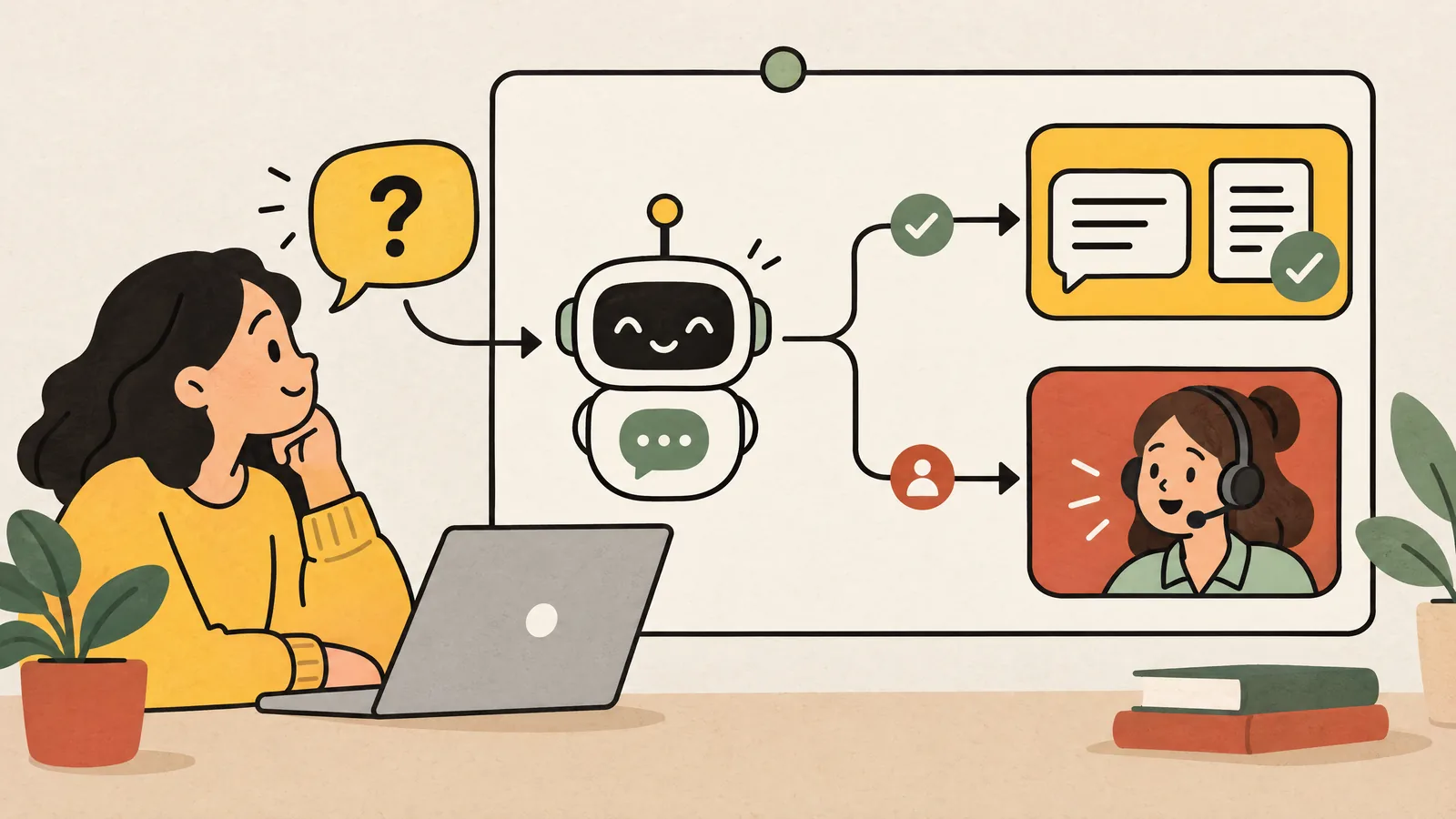
An AI agent for customer service is software that interprets a customer's request, finds relevant business information, and responds within rules you set. Depending on its connections and permissions, it may also check an order or perform an approved action. A useful agent knows when to stop and transfer the conversation to a person.
That last ability deserves more attention than a polished demo. A quick answer about shipping hours helps; a confident promise to refund an excluded item creates work for everyone. Your buying decision should start with responsibility, then move to features.
At txt.me, our live chat platform pairs AI answers from a business's knowledge base with human operators. The AI hands off when it's unsure, a customer requests a person, or money or complaints are involved. That shared responsibility is the model this guide examines: routine answers have clear boundaries, and exceptions have an owner.
What should an AI agent for customer service actually do?
A demo can make several different products look alike. A visitor types a question, a reply appears, and everyone calls it an agent. But answering a policy question and changing a delivery address require different controls.
A useful evaluation separates the work into levels:
| Work level | Concrete example | What you need to verify |
|---|---|---|
| Answer | Explain the published return window | The response matches the current policy |
| Retrieve | Show an authenticated customer's shipment status | Access is limited to that customer's order |
| Act | Submit an approved address change | The system checks authorization and records the action |
| Escalate | Refer a disputed refund to a person | A named queue receives the transcript and next step |
You don't need every level on day one. A small retailer may get enough value from accurate policy answers and reliable escalation. Adding order-changing tools before the team can review their use introduces a different kind of risk.
How is this different from a chatbot?
A scripted chatbot generally follows predefined paths. A generative agent can interpret varied wording and select relevant information; some agents can also use software tools. There's overlap, and product labels aren't a reliable specification. Our chatbot versus live chat comparison covers the broader choice between automation and direct human conversation.
The better buying question is specific: “Can you show how this system handles a damaged item bought during a final-sale promotion?” A vendor's answer should reveal its information sources, permission checks, and escalation behavior. Fluency alone won't tell you those things.
A narrow first scope makes errors easier to find
Say a candle shop in Tucson sells a $28 jar candle and gets 400 website visits a day. These are illustrative details, not a customer case study. Visitors ask about scent strength, summer shipping, and gift packaging. One buyer reports that a jar arrived cracked.
Those requests shouldn't receive identical treatment. Published packaging information is a reasonable starting task. A damage complaint may require photos, an exception decision, and a person who can approve a remedy.
Your recent conversations provide a better starting list than a vendor's template. A manageable first scope is one group of frequent questions with stable written answers. For each question, your support lead can record the approved source, information the visitor must provide, and the point where automation stops.
This keeps the pilot interpretable. If the agent struggles with one return policy, you can identify the gap. If it covers every department at launch, a bad response may come from conflicting documents, missing permissions, or an unclear process.
There's a useful trade-off here. A narrower agent may transfer more conversations initially, but each transfer can expose a fixable information gap. Broad coverage can look better while hiding incorrect answers. A staged customer service automation plan gives you room to expand after review.
Reliable answers begin with owned information
The agent can't resolve a contradiction that your team hasn't settled. Suppose your shipping page says dispatch takes two business days, while an old promotional PDF promises next-day dispatch. Importing both gives the system competing instructions.
The National Institute of Standards and Technology's 2024 Generative Artificial Intelligence Profile describes confabulation: generating and confidently presenting false or erroneous content. It also recommends checking sources and citations in generated outputs.[1] Supplying business documents can support grounded answers, but it doesn't guarantee accuracy.
For your first topic, one named owner should approve the source material and remove superseded versions. Each policy needs an effective date, its exceptions, and an escalation route. This makes updates accountable instead of leaving everyone to assume someone else changed the help page.

An unanswered question needs an approved response
Suppose a shopper asks whether a candle fragrance is safe around a pet bird. If your documents don't establish that, a helpful-sounding guess could cause harm. The agent should explain that it can't confirm the answer and route the question to the appropriate person, without inventing reassurance.
That behavior needs testing. During evaluation, a reviewer should be able to trace each policy claim to an approved passage. Unsupported details deserve attention even when the overall answer sounds reasonable. A made-up carrier cutoff is still wrong inside an otherwise accurate shipping explanation.
Ownership matters after launch, too. A policy change should trigger an update and another test of affected questions. Otherwise, your marketing team can announce a new return window while your chat assistant continues describing the old one.
Reading and changing an account need different permissions
An order lookup can feel harmless until the agent displays another customer's address. The problem isn't necessarily the wording of its answer; it may have more access than the task requires.
OWASP's 2025 guidance on excessive agency recommends limiting tools and permissions, requiring human approval for high-impact actions, and enforcing authorization in connected systems.[2] For a support team, that means an instruction such as “don't issue unauthorized refunds” isn't an adequate substitute for restricted refund access.
A first integration can be read-only. Where an action is necessary, the connected application should verify the customer and enforce its own rules. The agent shouldn't decide whether an unverified visitor may redirect a parcel. Nor should a general support connection expose every account because that's easier to configure.
A practical acceptance test asks the system to do something just outside its scope. Can it cancel an order when it has lookup access only? Can a request in the chat persuade it to skip identity checks? The expected result is a refusal or approved handoff, with no unauthorized change.
Data collection needs the same discipline. The Federal Trade Commission's Protecting Personal Information: A Guide for Business recommends collecting and retaining sensitive personal information only when there's a legitimate business need.[3] Applied here, that supports asking for the minimum information needed for the task rather than collecting full payment details in an ordinary support conversation.
Before signing, you should know who can access transcripts, how long they're retained, whether they're used to train models, and how deletion requests are handled. These answers belong in a written agreement, not a sales reassurance.
A human handoff needs a destination and context
“I'll connect you with someone” becomes a service failure if nobody receives the conversation. Customers then repeat themselves, while your team has to reconstruct what the AI already promised.
Handoff means transferring the conversation and responsibility to a human. A useful transfer includes the customer's request, verification status, relevant source material, actions attempted, and anything still unresolved. The complete transcript should remain available because a summary can leave out a condition that changes the decision.

The routing rule needs an owner. A refund dispute might go to a supervisor queue, while a missing installation answer goes to technical support. A helpdesk ticketing system can preserve that work when an immediate reply isn't possible.
Customers should also have a visible way to request a person. A clear introduction that identifies the automated assistant sets expectations; pretending it's a human creates confusion when its limits appear.
Off-hours handling deserves its own test. If no operator is available, the message should describe the real next step and the response window your team can meet. It shouldn't imply someone is joining now. Businesses without their own coverage can evaluate human support coverage alongside automation, because an escalation rule needs actual staffing behind it.
Difficult conversations belong in your pilot tests
A demonstration usually starts with a well-formed question. Your visitors may type “package gone,” paste an outdated offer, or ask two questions in one message. A useful test set reflects that messiness without exposing unnecessary personal information.
Your team can build it from anonymized historical requests and deliberately awkward variations. It should include a question the agent can answer, one with missing facts, and a request it must refuse. Conflicting policy documents and unavailable human coverage deserve cases of their own.
The expected behavior belongs beside each case. For a routine question, the reviewer checks factual accuracy and source support. For an account request, the reviewer checks verification. For a complaint, the reviewer checks routing and what the customer was told. A single overall “good answer” score can hide a serious failure in one of those areas.
Human assistance can be a sensible intermediate step. In The Quarterly Journal of Economics in 2025, Erik Brynjolfsson, Danielle Li, and Lindsey Raymond studied 5,172 customer-support agents. Access to AI assistance increased issues resolved per hour by 15% on average.[4] The study examined suggestions for human workers at one firm; it doesn't establish the same result for autonomous support at your business.
That distinction matters when setting expectations. If your policies change frequently, having people review AI-generated drafts first can reveal mistakes before customers receive them. It's slower than immediate automation, but you gain evidence about where the system is dependable.
Once the approved cases pass, a limited pilot can expose real customer wording. A serious privacy or permission failure should pause the affected capability. Routine wording problems can feed the next update without shutting down unrelated tasks.
Resolved problems matter more than closed chats
A closed chat doesn't prove the customer received help. An agent can end a conversation after an incorrect answer, or a frustrated visitor can leave and return by email.
Containment usually describes conversations kept within automation, without human transfer. It's useful operationally, but your team needs a separate measure of verified resolution. The definition should require an accurate answer or completed approved action, with no related failure found during your chosen follow-up period.
For example, suppose a pilot receives 200 requests and labels 80 resolved without a human. Review finds that eight of those weren't resolved correctly. The working is 80 − 8 = 72 verified resolutions; 72 ÷ 200 × 100 = 36% of all pilot requests. These are hypothetical results, not a forecast.
The denominator matters. Reporting only eligible requests can make a narrow deployment look more effective across the whole inbox than it is. Both views can be useful if they're labeled clearly.
Your customer service metrics should also cover repeat contact and the time customers wait after transfer. Fast automated replies won't compensate for a human queue that stalls all afternoon. And comparisons need similar request types: an easy shipping question shouldn't be treated as equivalent to a disputed charge.
Budgeting follows the same logic. A subscription or usage charge is one expense; knowledge maintenance, quality review, integration work, and human handling remain. A pricing proposal should explain what counts as a billable resolution, whether reopened cases count again, and which work falls outside the quoted amount. A cheaper answer isn't a saving if your team must correct it later.
The right boundary is one your team can maintain
A capable agent can still disappoint if nobody owns its policies or receives its escalations. The strongest starting scope is a service promise your team can inspect and keep.
Before expanding, you should be able to name the approved tasks, the person responsible for their source material, and the destination for exceptions. There should be evidence that the agent respects those limits under awkward questions, not just friendly ones.
So the next buying conversation can start with one request: a demonstration using your real policy and an exception it doesn't cover. An honest stop, followed by a well-routed handoff, tells you more about readiness than another flawless answer to a rehearsed question.
References